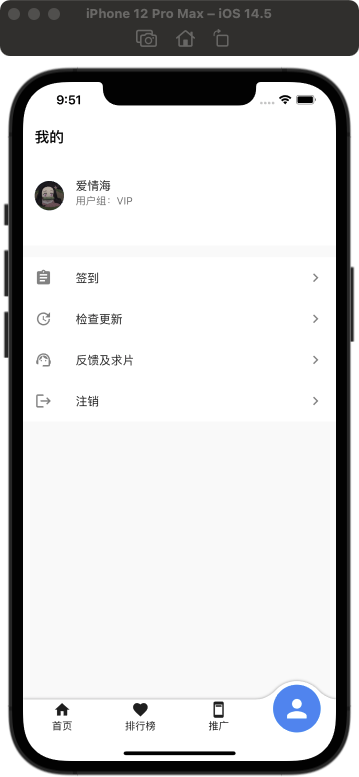
New APP planned for 9/'21: preview and statement
For the past two months, I have been learning new technologies again. Those familiar with me know I do not simply repeat projects using tools I already know. When a new idea appears, I first consider whether modern technologies from around the world can implement it. If so, I become motivated to build it. That is why you see me continuously adopting new technologies in product updates; many other experiments are less visible.
For this new APP, I studied flutter again and reorganized everything using model-view-controller, the familiar MVC approach, with a strict, clear folder structure. Rather than directly connecting to the efvcms api, it uses the separate cms in-memory caching server. For example, your EFVCMS system may be in Germany and the separate CMS on a Hong Kong server. The APP connects directly to that Hong Kong separate cms, where the separate cms serves data. The separate cms uses sapper, a technology that became popular abroad in 2020. This cms is more than a cms: it is also an endpoint memory-cache server. Each request to the EFVCMS API caches its response in the separate cms memory using redis. Subsequent reads use that local cache. Similarly, the app connects to the separate CMS api, reading data directly from the Hong Kong vps, so the app becomes dramatically faster. The difficulty is that developing the APP requires two API sets: the efvcms api and separate cms API. Each development session uses more than 4 windows. It is challenging, so please be patient; it is nearly ready.
Technologies I have learned include react, reactnative, vue, svelte, sapper, nodejs, golang, flutter and graphql. I first used reactnative for an app, but its results were disappointing, so I moved to flutter, from google. I have also built forums with vue, vuetify and nuxtjs. For nodejs alone, I have studied more than 5 frameworks: koajs, keystonejs, expressjs, strapi and sails. I am a technology enthusiast, so I do not respond to outside criticism: products are secondary, while technical ability remains mine.
Consider scrolling text in cloud transcoding. Other systems generally use a global ASS, write effects in an ass file and add ass=glogal.ass during transcoding. That is straightforward to develop. One competing transcoder continually criticizes me, but its entire program has fewer than 3000 lines. I could reproduce it in a week, but such a simple project is unnecessary. My own scrolling-text implementation using ffmpeg command-line functions alone contains more than 1000 lines.
To conclude: one who does not contend cannot be contended with.
APP preview screenshot